


By IQI Editorial Team
New launch got the showroom and the free gifts. But a subsale property gets you something better: a real unit you can walk into, a real neighbourhood you can check, and keys in months, not years.
Whether you’re buying for own stay or eyeing a unit to renovate and flip, the process is the same. And honestly, it’s not that complicated once you know the steps.
This guide walks you through buying a second-hand house in Malaysia in 7 steps, what to check before you sign anything, what it really costs, and the maths every flipper needs to see first.
TL;DR
- Subsale means buying a property from an existing owner, not from the developer.
- You pay a 2% to 3% earnest deposit when your offer is accepted, then top up to 10% when you sign the SPA.
- The bank lends based on the lower of the price or the bank’s valuation. If the valuation comes in low, you top up the gap in cash.
- Completion is usually 3 months from the SPA, plus a 1-month extension if needed. Leasehold titles can take longer.
- First home up to RM500,000? You pay zero stamp duty until 31 December 2027.
- Flipping within 3 years means 30% RPGT on your gain, plus possible loan lock-in penalties. Do the maths first.
What’s inside this guide
- TL;DR
- What Is a Subsale Property?
- How to Buy a Subsale Property in Malaysia: 7 Steps
- Step 1: Set Your Budget and Check Your Loan Eligibility
- Step 2: Find the Right Subsale Property
- Step 3: Make an Offer and Pay the Earnest Deposit
- Step 4: Get the Best Home Loan
- Step 5: What Should You Check Before Signing the SPA for a Subsale House?
- Step 6: Sign the SPA and Loan Agreement
- Step 7: Completion and Getting Your Keys
- Can You Buy an Under-Construction Property on Subsale?
- Thinking of Flipping a Subsale House? Do the Maths First
- Frequently Asked Questions
What Is a Subsale Property?
A subsale property is a property bought from an existing owner, not from a developer. Some people also call it a secondary market, resale or second-hand house.
It can be a 20-year-old terrace in PJ or a condo that was completed last year. As long as you’re buying from the current owner, it’s subsale.
Subsale vs new launch: which one suits you?
| Factor | Subsale | New launch |
|---|---|---|
| What you see | The actual unit, neighbours, traffic and all | A showroom and a brochure |
| Move-in time | Around 3 to 6 months | Often 2 to 4 years if still under construction |
| Cash upfront | 10% deposit plus fees | Lower, developers often absorb some fees |
| Price check | Compare with actual transacted prices nearby | Developer’s price, rebates and packages |
| Defects | No developer warranty, so inspect carefully | Developer fixes defects during the Defect Liability Period |
| Rent or flip | Can rent or renovate almost immediately | Wait for completion first |
Need a home now, or want to start earning rent fast? Subsale usually wins. Want more time to save? A new launch buys you that time.
How to Buy a Subsale Property in Malaysia: 7 Steps
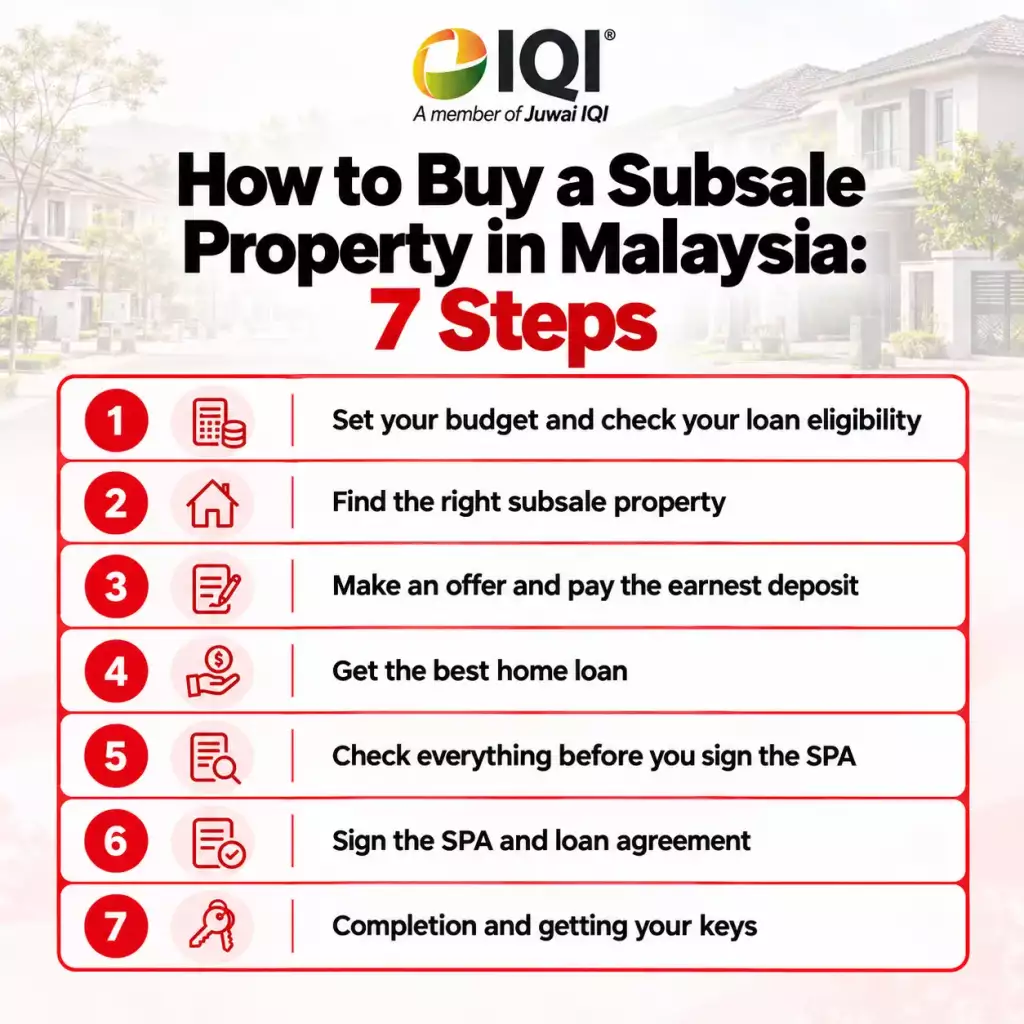
- Set your budget and check your loan eligibility
- Find the right subsale property
- Make an offer and pay the earnest deposit
- Get the best home loan
- Check everything before you sign the SPA
- Sign the SPA and loan agreement
- Completion and getting your keys
Step 1: Set Your Budget and Check Your Loan Eligibility
Don’t start with listings. Start with what the bank will actually lend you.
For your first two homes, banks usually finance up to 90% of the price. From your third housing loan onwards, Bank Negara caps it at 70%. So for most buyers, prepare at least 10% in cash, plus another 3% to 5% for fees.
Banks also check your DSR (Debt Service Ratio), which is how much of your gross salary already goes to debt repayments. Keep it under 60% to 70% to be safe.
Check how much you can borrow here:
Estimates for guidance only. Actual figures depend on the bank’s assessment, current rates, and your full financial profile.
Planning to renovate? Many buyers cap their reno budget at about 10% of the property value, especially for own stay. Flippers need to be stricter, more on that later.
Not sure how banks read your profile? See how DSR affects your home loan and how to check your CCRIS report.
Step 2: Find the Right Subsale Property
Listings are for shortlisting. The real decision happens when you go and see the unit.
- Location first: commute in actual jam, LRT or MRT access, schools, clinics, your daily kopi spot.
- Transacted prices: what similar units in the same block actually sold for, not just what sellers are asking.
- Building condition: lifts, corridors, car park, and how well the management is running the place.
- Tenure: freehold or leasehold, and how many years are left on the lease.
- For flippers: is there demand from buyers or tenants in this area, and how long do units take to sell?
Go at different times of day. A quiet Sunday morning can feel very different from a weekday evening with lorries outside.
Want to know where prices are heading? See the latest Malaysia subsale price data, or browse subsale homes on IQI.
Not sure what to check during a subsale viewing? Save these tips from a real estate agent before your next visit.
Step 3: Make an Offer and Pay the Earnest Deposit
Found the one? You make an offer through a Letter of Offer to Purchase (OTP), sometimes called a booking form.
Once the seller accepts, you pay an earnest deposit of about 2% to 3% of the price. This shows you’re serious and takes the unit off the market.
Before you sign the OTP, check these:
- Who holds the deposit. Ideally the agent or lawyer holds it as stakeholder, not the seller directly.
- What happens if your loan is rejected. A good OTP refunds your deposit in that case.
- How long you have to sign the SPA, usually 14 to 21 days.
- What stays with the unit: aircond, built-in wardrobes, kitchen cabinets, water heaters, curtains.
Write everything down. If it’s not in writing, it didn’t happen.
Buyers usually don’t pay the agent’s commission on a subsale. The seller does, typically 2% to 3%.
Step 4: Get the Best Home Loan
Apply to at least two or three banks. Even a 0.1% rate difference adds up to thousands over a 30 to 35 year loan.
Compare more than the interest rate:
- Lock-in period and early settlement penalty (very important for flippers)
- Flexi, semi-flexi or term loan
- Margin of financing offered on your profile
- Legal fee subsidies or zero-moving-cost packages
Bank value vs market value: why it matters
The bank sends a valuer to check what the property is worth. It then lends based on the lower of the purchase price or that valuation.
Example: you agree to buy at RM600,000, but the bank values it at RM550,000. At 90%, the bank lends RM495,000 instead of RM540,000. That RM45,000 gap? You top up in cash.
So ask your agent for a realistic valuation range before you commit, especially if you’re stretching the budget.
How much is the monthly installment?
Plug in the price, rate and tenure to see what you’ll pay each month:
Estimates for guidance only. Actual figures depend on the bank’s assessment, current rates, and your full financial profile.
Compare packages in our latest house loan interest rates and flexi vs semi-flexi vs fixed loans.
Found a subsale unit but not sure the price is right?
An IQI agent checks recent transacted prices in the same area, gives you a realistic valuation range, and helps you negotiate before you pay a single sen. Free, and no pressure.
Or browse now: subsale homes on IQI.
Step 5: What Should You Check Before Signing the SPA for a Subsale House?
This is the step most first-timers rush. Subsale homes don’t come with a developer’s defect warranty, so whatever problem you miss now becomes your problem later.
Run through this checklist with your lawyer and agent before you sign the Sale and Purchase Agreement (SPA):
Paperwork checks
- Land search (carian rasmi): confirms the registered owner, the title type and whether the property is charged to a bank.
- Seller’s identity matches the name on the title.
- Title status: has the individual or strata title been issued, or is it still under the master title?
- Restrictions: Bumiputera lot, leasehold consent requirements, or caveats on the title.
- Remaining lease, if leasehold. Short leases can make it harder to get a loan or sell later.
- Outstanding bills: quit rent (cukai tanah), assessment (cukai pintu), maintenance fees and sinking fund. Ask for the latest statements.
- Renovation approvals for landed homes, especially extensions. Illegal extensions can become your headache.
Physical checks
- Water leaks, damp walls and ceiling stains
- Cracks in walls and floors
- Wiring, DB box and power points
- Water pressure, piping and toilets
- Roof and gutters for landed homes
- Windows, doors and grilles
Agreement checks
- List of fixtures and fittings that come with the unit
- Any known defects you’ve agreed on, in writing
- Loan condition: the SPA should protect you if your loan doesn’t get approved
- Completion period and extension terms
Learn more about why property valuation matters and the difference between leasehold and freehold.
Step 6: Sign the SPA and Loan Agreement
Once everything checks out, you sign the SPA and top up your deposit to 10% of the price. Your lawyer holds this as stakeholder.
You’ll also sign the loan agreement with your bank. Then the lawyers handle the rest:
- Stamping the SPA and loan agreement
- Preparing the Memorandum of Transfer (MOT), the document that moves the property into your name
- Getting state consent if the property is leasehold or has restrictions
- Redeeming the seller’s existing bank loan, if any
How much does it cost to buy a subsale property?
| Cost | How much |
|---|---|
| Deposit | 10% of the price (2% to 3% earnest plus the balance at SPA) |
| Stamp duty on the MOT | 1% on the first RM100,000, 2% up to RM500,000, 3% up to RM1,000,000, 4% above |
| Stamp duty on the loan agreement | 0.5% of the loan amount |
| Legal fees (SPA and loan) | 1.25% on the first RM500,000 and 1% on the next RM7 million, for each agreement, plus disbursements |
| Valuation fee | Often paid upfront and sometimes refunded or absorbed by the bank |
Worked example: on a RM450,000 subsale with a 90% loan, MOT stamp duty is RM8,000 and loan stamp duty is RM2,025. Legal fees come to about RM5,625 for the SPA and RM5,060 for the loan agreement.
First home and priced up to RM500,000? Malaysian first-time buyers pay zero stamp duty on both the MOT and loan agreement until 31 December 2027. That saves this buyer RM10,025.
Get a full estimate with the property transaction fees calculator, and see the hidden fees most buyers forget.
Step 7: Completion and Getting Your Keys
The SPA gives a completion period, usually 3 months, with a possible 1-month extension. Late payment interest usually applies during the extension.
During this time, the bank releases the loan amount. Part of it pays off the seller’s old loan, and the rest goes to the seller.
Once full payment is made, you get vacant possession, which simply means the seller moves out and hands you the keys.
Your lawyer also settles the apportionment. That just means splitting bills like quit rent, assessment and maintenance fees fairly between you and the seller, up to the handover date.
Before taking the keys, do a final walk-through. Check that the unit is in the agreed condition and the fixtures are still there.
How long does a subsale purchase take?
| Stage | Typical timing |
|---|---|
| Offer accepted, earnest deposit paid | Day 0 |
| Loan approval | 1 to 3 weeks |
| SPA signed, deposit topped up to 10% | Within 14 to 21 days |
| Completion period | 3 months, plus 1-month extension if needed |
| Leasehold or restricted title | Longer, as state consent is needed |
Can You Buy an Under-Construction Property on Subsale?
Can or not? Yes. If the original buyer wants to sell before the project is completed, you can buy their unit on subsale.
The difference is that there’s no title to transfer yet. Instead, the original buyer’s rights under the developer’s SPA are transferred to you through a deed of assignment.
- The developer must give consent, and usually charges an admin fee.
- You take over the remaining progressive payments to the developer.
- Your bank will check the developer, the project progress and the original SPA.
- You still get the developer’s Defect Liability Period once the unit is completed.
It can be a good way to get into a popular project at today’s price. Just make sure your lawyer checks the developer’s consent conditions first.
Thinking of Flipping a Subsale House? Do the Maths First
Buy low, renovate, sell high. Sounds simple, right? In Malaysia, the costs of buying, holding and selling eat into your profit fast.
Here’s what flippers need to factor in:
- RPGT (Real Property Gains Tax): 30% on your gain if you sell within 3 years, 20% in year 4, 15% in year 5 and 0% from year 6 for Malaysian citizens.
- Loan lock-in: many home loans charge an early settlement penalty, often around 2% to 3% of the loan, if you sell within the first few years.
- Financing limits: from your third housing loan onwards, banks lend up to 70% only.
- Holding costs: loan interest, maintenance fees, quit rent and assessment every month until it sells.
- Selling costs: agent’s commission (with SST) and your own lawyer’s fees as the seller.
- RPGT retention: the buyer holds back 3% of your sale price until your RPGT is settled.
Worked example: buy at RM400,000, sell at RM500,000 a year later
Assume a second property, 90% loan at 4.2%, RM30,000 renovation, sold after 12 months at RM500,000.
| Item | Amount |
|---|---|
| Price gain (RM500,000 minus RM400,000) | +RM100,000 |
| Buying costs (stamp duty, legal fees, valuation) | About RM19,500 |
| Renovation | RM30,000 |
| Holding costs for 12 months (interest, maintenance, taxes) | About RM20,500 |
| Selling costs (agent fee with SST, seller’s legal fee) | About RM19,750 |
| Early settlement penalty (2% of loan) | About RM7,200 |
| RPGT at 30% (after exemption) | About RM8,500 |
| Net result | About RM5,400 loss |
Yes, you read that right. Rugi. A RM100,000 jump in price can still end in a loss once every cost is counted.
Flips work when you buy well below market, not when you hope prices rise. Smart flippers also pick loans without heavy lock-ins, keep renovations to what buyers actually pay for, and often rent the unit out while waiting for a better time to sell.
Figures are rounded estimates for illustration. RPGT, penalties and fees depend on your loan, your timing and your full situation, so get advice from a tax agent and your bank.
Renovating to sell? See home improvements that actually add value.
Own stay or flip, buy your subsale with someone who knows the area.
An IQI agent helps you spot fairly priced units, checks the paperwork, coordinates the lawyer and bank, and walks you from offer to keys.
Speak to an IQI agent for free, personalised advice.
Frequently Asked Questions
Subsale means buying a property from an existing owner rather than from a developer. It is also called a resale, secondary market or second-hand property, and can be anything from an old terrace house to a recently completed condo.
Usually 10% of the price. You pay an earnest deposit of about 2% to 3% when your offer is accepted, then the balance to 10% when you sign the SPA. Set aside another 3% to 5% for stamp duty, legal fees and valuation.
Usually not. In a typical subsale, the seller pays the agent’s commission, commonly 2% to 3% of the price. Confirm this in writing before you sign the offer.
Malaysian first-time buyers purchasing a home priced up to RM500,000 are exempt from stamp duty on both the MOT and the loan agreement, for SPAs signed until 31 December 2027. This applies to subsale homes too.
*source from iqiglobal.com/blog/





Join The Discussion